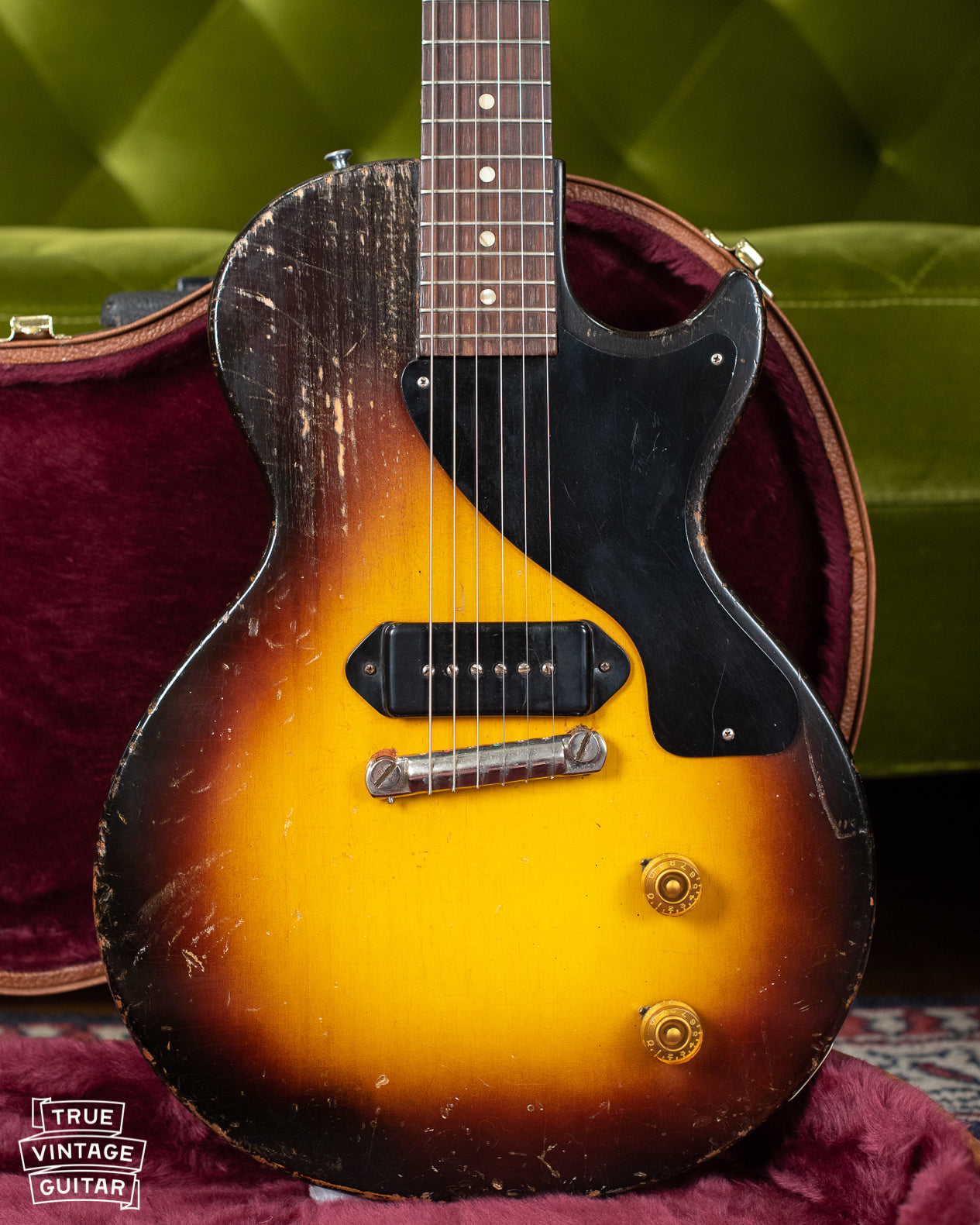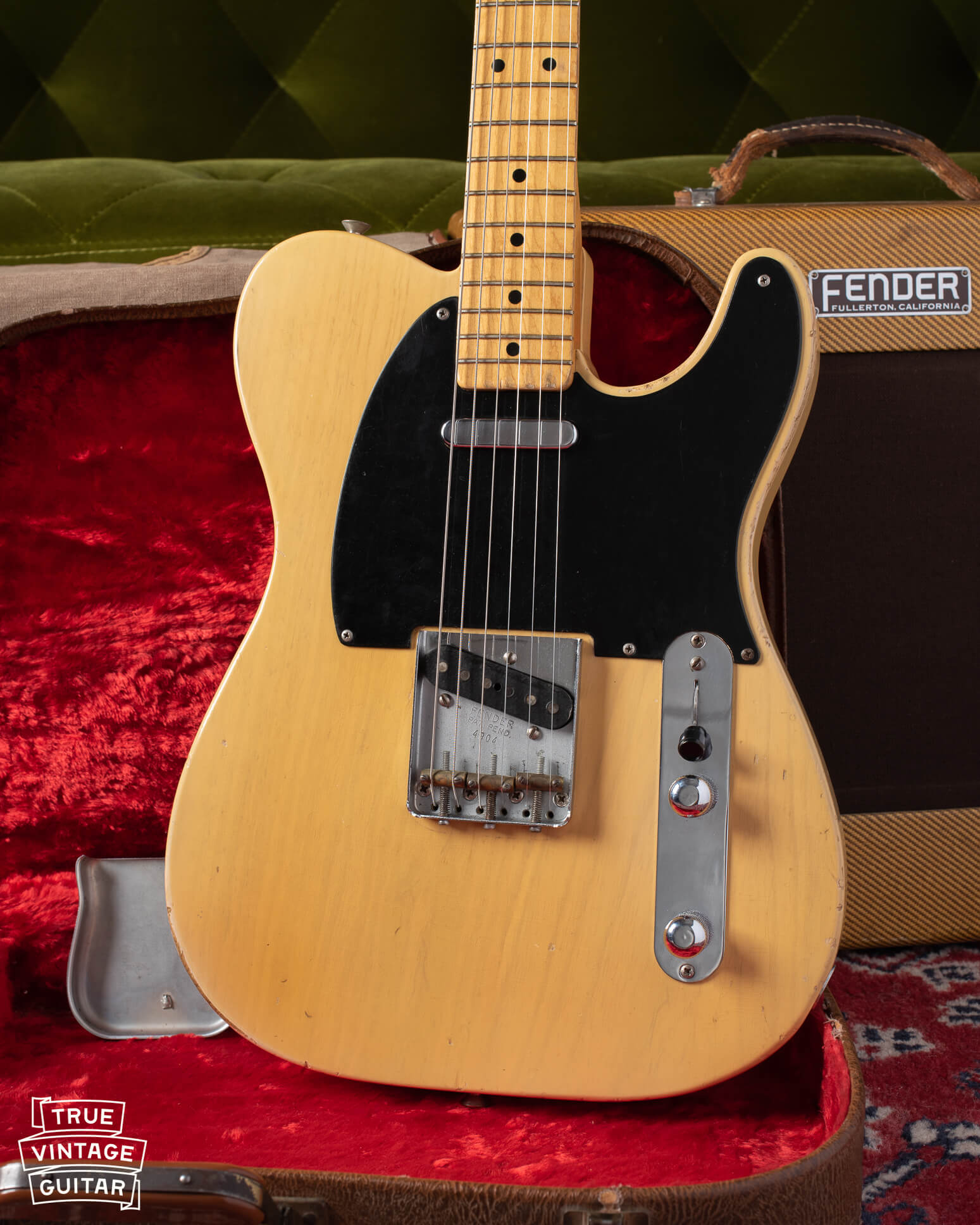

If you spent time looking at vintage guitars on social media this past spring, you may have come across the story of how this 1959 Gibson Les Paul Standard came out from under the bed outside of Houston, Texas. You'd be smart to be skeptical about that story, but I can confirm that in this case it's actually true. In a world full of Burst reproductions and even some outright fakes, this guitar is 100% real and a stunning example of an original 1959 Burst!
 As I sat in the lobby of the bank with the daughter of its longtime owner, I asked her to recount as much of the history of the guitar as she could remember. She believes that her father, Morris, purchased the guitar from a music store in Baytown, Texas. She thinks that he was in middle school when he got it, which would put his acquisition of the Burst in about the mid 1960s. Morris played it at his local community center with the Pick & Grin band until his death in 1997. The guitar passed to his daughter, who stored it under her bed for 29 years until after her husband passed away. Her nephew remembers seeing it when it passed to her in 1997 but confirms that it truly did stay under the bed until recently.
What Makes a 1959 Gibson Les Paul Standard Special?
The Sunburst-era Gibson Les Paul Standard is the most valuable standard-production guitar in the world, and the features specific to 1959 are what drive buyers to consider it the most valuable year of the model. This was a regular Gibson catalog model—not a one-off, custom-color, or special version. Gibson shipped at least 643 examples of the Les Paul Standard in 1959 alone, so it wasn't a particularly rare guitar at the time, even if it has become one over the past several decades.
The 1959 Les Paul Standard is so special because it is the only year in which these features overlap: a medium-fat neck profile, a tastefully faded Sunburst finish, wide frets, and, often, a figured maple top.

Gibson's Les Paul Model debuted in 1952 with a gleaming gold finish, a poorly executed Les Paul-designed tailpiece, and a shallow neck angle that didn't allow a player to mute the strings with the palm of the hand. The model was gradually updated throughout the 1950s until slumping sales triggered another major change in the middle of 1958: the introduction of the Cherry Sunburst finish. Sales didn't surge as Gibson had hoped. By the end of 1960, with the transition occurring mostly during early 1961, the thick, maple-capped, single-cutaway body was replaced by a thinner, solid-mahogany, double-cutaway design finished in Cherry Red. It wouldn't be renamed the SG Standard until a few years later.
The Sunburst Les Paul Standards made from 1958 through 1960 are the most valuable, but the 1959 model is the one for which most buyers are willing to pay a premium. This is largely because of its neck profile, wide frets, and the tasteful way the Cherry Red often fades on guitars from that year. Most Les Paul neck profiles from 1952 through 1958 are quite fat, measuring about 0.90 inches deep at the first fret and 1.00 inch at the 12th fret. They became slimmer in 1959, with measurements typically falling in the 0.85-to-0.95-inch range. By early 1960, the necks were generally slimmer still, often measuring approximately 0.80 to 0.90 inches. Wide frets were introduced on the Standard in 1959, following their introduction on the Junior, Special, and TV Model in 1958. The aniline red dye used in the Sunburst finish also tended to fade especially attractively on many 1959 examples. For all these reasons and more, the Bursts made in 1959 are the most coveted.
What is a 1959 Gibson Les Paul Standard Worth?
 As much as a house. And like houses, '59 Bursts vary widely in value widely based on the top figure, condition, and the amount of color left in the top (in that order). Each one should be evaluated on a case-by-case basis. You can contact me here for an appraisal on your vintage Gibson Les Paul: Vintage Guitar Appraisal.
I've found that most 1959 Gibson Les Paul Standards are worth in the $300,000 to $500,000 range, with outliers in the $200,000 range and up to $600,000 range.
The most significant factor of the value of a 1959 Gibson Les Paul Standard is the amount of figure in the maple cap (condition and originality may overtake this if the condition is exceedingly poor). As long as the condition is in the "Good +" range, the top figure is what drives buyers.
Gibson historian Robb Lawrence once interviewed Ted McCarty himself on the subject of the figured maple tops. Ted McCarty's statements in that interview surely suggest that they prioritized the figured maple and had developed a system for picking only the trees most likely to be figured.
“Maple you have to hunt and hunt for. You buy it wherever you find it because curly maple is one of those things that nobody seems to know ahead of time that it's going to be curly.… He and I and John Huis, to the best of my knowledge, are the only three people alive who can look at a maple tree and tell you whether it's curly or not before you cut it down.…”
Gibson didn't mention the figure in its catalog advertisement presumably because not all of them are figured. But the example used for the catalog image is certainly a nicely figured one! Gibson was known for using figured maple for the backs and sides of high end arch top guitars like the L-5 since the early 1920s, so it's no surprise to find it here. Buyers for '59 Bursts are not typically price sensitive when a big figured top Burst is available.
But like any other vintage guitar, Burst buyers are quite sensitive to the condition and originality of the guitar. A refinished guitar is typically worth about half as much of the value of a comparable guitar with its original finish. A neck break and subsequent repair used to affect buyers for the same amount, but they've become less sensitive to that in the past decade (especially if it has a big figured top!). Original pickups and rings are extra important, but tuners and frets are not typically going to deter a buyer.
You can contact me here if you're considering selling an old Gibson guitar: Sell a Gibson.
Original Price of the Les Paul Standard in 1959

Gibson's catalog and price lists from 1959 list the price of the Les Paul Standard in 1959 as $265.00 for the guitar, $42.50 for the style 535 Faultless plush-lined case, and $30.00 for the rarely ordered "ZC-LP Deluxe zipper case cover". In 2026 dollars, the Les Paul Standard would cost about $3,040. The Standard wasn't close to the most expensive electric guitar in the 1959 Gibson catalog, which was the ES-355 TDSV at a price of $600.00.
The Legendary 9 0600 Serial Number Range
After looking at so many examples of 1959 Les Paul Standards, a pattern emerges: guitars from the same serial number range often share common characteristics. Remember that Gibson manufactured batches of guitars on racks that held about 40 guitars each (multiple racks were often used in a batch). Since the guitars were manufactured together, it's common to find similar features in neck size, top color, weight, top figure, and bobbin color. You can check out multiple examples of serial number ranges of '59 Les Pauls at Burstserial.com. Keep in mind that the appearance of a guitar or serial number on the website is NOT proof of a real original guitar.
9 0600 Color
The most consistent feature I notice as I look at the 9 0600 range is the color—or lack thereof—of the Sunburst finish. The aniline dye that Gibson used to shade the semi-translucent Sunburst finish on Les Paul Standards in 1959 is well known to fade or change color after prolonged exposure to light.
I took this photograph of the original top color on 9 0683 while I was at the bank buying the guitar. Notice how the color beneath the pickguard is much richer, darker, and far more purple than the rest of the guitar. This color survived because the pickguard sits very close to the top in this area, blocking much of the light that causes the dye to fade.
Compare the color of the catalog Les Paul Standard pictured above with the color of this '59 Burst. This example has faded to the point that the area once forming the darker outer edge of the Sunburst has developed a greenish hue. A survey of other Bursts in the 9 0600 range shows a consistent pattern across the run, except for one example with a darker tobacco-style finish.

9 0600 Neck Size
As I was discussing this serial number range with a friend, he mentioned that most of the guitars in the 9 0600 range have very fat necks. The typical measurement I saw is about 0.88" deep at the first fret and 0.98" deep at the 12th fret. This is only about 0.02" slimmer than the typical fat 1958 Les Paul neck profile, so it's pretty fat!
My Hot Take: The Flame Top Was a Happy Accident
 Have you ever thought about why there's a maple cap on the body of a Les Paul Standard? Remember that for the first 6 years of the life of the model, the maple cap was completely hidden by the opaque gold finish. Why would Gibson add this expensive step to the manufacturing process if you couldn't even see it? Is the tone of the guitar out the amplifier THAT much different than the same guitar but with a solid mahogany body with no maple cap? Yes; but the effect is probably not that significant with a bridge that's mounted to threaded posts going into the body.
The effect was exaggerated at the inception of the Les Paul Model with the trapeze style bridge. Gibson Historian Gil Hembree notes that Gibson experimented with different body construction style after trying all-maple and all mahogany.
According to Gibson historian Gil Hembree, Gibson experimented with different combinations of maple and mahogany while developing the Les Paul:
“An all-Maple body had great sustain, but was deemed too heavy. An all-mahogany body didn't have enough sustain. So they tested various combinations to see how long a string would vibrate.”
Remember that the 1952 and early 1953 Goldtop Les Pauls utilized a trapeze style bridge that didn't have threaded posts into the body. Instead, the string tension held the bridge height posts on metal platforms that sat on top of the face of the body (and therefore the maple cap). The engineers at Gibson noticed that the maple cap yielded a slightly brighter tone that balanced out the darker sound of the P-90 pickups.
But there was a flaw in Gibson's early design that nearly any player would have spotted (except the engineers at Gibson): the early tailpiece style Les Pauls were designed with a neck angle that required the strings to wrap under the bridge instead of over top. This design made it difficult for players to mute the strings with their palms. The design was corrected with the wrap tail bridge introduced in 1953 then further refined later that year by increasing the neck pitch to allow for low action with strings wrapped over top of the bridge.
Once the Tune-O-Matic bridge was introduced (on the Goldtop at least) in late 1955, the effect of the maple cap was likely less dramatic than it had once been, but Gibson kept it. The 1958 Cherry Sunburst redesign revealed the maple cap and presumably Gibson prioritized the tops with pleasing figure, but not always. The catalog picture of the model exhibits this maple figure that harkens back to the use of figured maple on the back of high end archtops in the 1920s and 1930s, but not every LP Standard was that lucky. Figured tops were not mentioned in the catalog copy.
In my opinion, it's less likely that the Les Paul Standard would have a figured maple top in 1958 if the tonal experiments in 1951 and 1952 hadn't revealed the perfect amount of sustain from a combination of maple cap on a thick mahogany body.
Key Features of the 1959 Gibson Les Paul Standard
| 1959 Gibson Les Paul Standard: Key Features | |
|---|---|
| Body Style | Single Cutaway with carved top |
| Wood Species | Honduran Mahogany, Hard rock maple, Brazilian Rosewood |
| Neck profile | Medium fat (0.88" - 0.98") |
| Nut Width | 1 11/16" / 43mm |
| Frets | Most with wide frets; some early examples with skinny frets |
| Pickups | PAF humbucking, long magnet, ~7.5k ohms resistance, black or white bobbin |
| Tuners | 3+3 individual plate, single line, single ring, |
| Potentiometers | Centralab 500k, audio taper |
| Capacitors | Sprague "Black Beauty" (collector term "Bumblebee") |
| Cases | Brown exterior, pink plush interior by Stone, Lifton, Geib |
| Common issues | Refinishes, neck repairs, replaced electronics, planed fretboards, replaced pickups, removed pickup covers |
The 1959 Les Paul Standard Control Cavity

One of the first places I wanted to inspect when I arrived at the bank to buy this guitar was the control cavity. Underneath the large plastic plate on the back of the body resides some of the clearest evidence that the guitar in question is a real original 1959 Les Paul and not one of the many common fakes and reproductions. I was instantly stunned at how clean and original this cavity remained throughout so many decades. This is exactly what original solder should look like on a real Burst.
Further Reading on the 1959 Gibson Les Paul Standard
Out of the many great books on original 1950s Gibson Les Paul guitars, the books mentioned here are my absolute favorites. Short of owning one yourself, taking the time to read through this list will put you on the fast track to in depth knowledge about the guitar we all love the most.
The Early Years of the Les Paul Legacy 1915 - 1963
Robb Lawrence's Les Paul Legacy books are the first place I'd direct a future Les Paul nerd to go. The history of the man himself is integrally intertwined with the guitar bearing his name, even if he didn't design it himself. Looking for the answer to the question of "Why did the Les Paul signature remain on the headstock of SG body guitars well into 1963?" Robb's book has the answer. Amazon Affiliate link here: https://amzn.to/4gxDw72.
The Beauty of the Burst
Yasuhiko Iwanade's The Beauty of the Burst offers a great sampling of the Sunburst Les Paul guitars made in 1958, 1959, and 1960. This book is a great reference piece that gives the reader an overview of the different types of wood figure, color fades, neck profiles, and other features that a buyer should know to get a better idea of what original examples look like. https://amzn.to/4xDBrg6
Burst Believers I - IV
The Burst Believers series of books is a treat for the eyes of the vintage Sunburst Les Paul lover. It's mostly photos of every real Burst they could find but does have some of the stories of each guitar in there. You'll love it. https://amzn.to/4iEZuX4
Want More Bursts? 1958 & 1960 Here
There's more to life than just 1959 Les Pauls. They also made them in 1958 and 1960. This example from 1959 is the fourth Burst I've had the privilege of owning. Here are some other Bursts that have come through my shop.
1958 Les Paul Standard
I've had the privilege of sourcing two uncirculated 1958 Gibson Les Paul Standards from early in the Cherry Sunburst era (late 1958). The first Burst I ever owned was the 1958 Les Paul Standard "PJ" I purchased in South Africa. Now owned by Joe Bonamassa, PJ gets to tour the world again and make music for all to hear: 1958 Gibson Les Paul Standard PJ South Africa.
The second 1958 Gibson Les Paul Standard I found lived in Oslo, Norway for decades until 2023. This guitar is an earlier example with bright Cherry Red Sunburst and big top figure: 1958 Gibson Les Paul Standard Norway.
1960 Gibson Les Paul Standard "Rosie"
The most well-preserved Burst I've ever seen is this 1960 Gibson Les Paul Standard named for its original owner: Rosie. Hailing from rural Illinois, Rosie had no idea that the guitar her parents gave her in the early 1960s would turn out to be so valuable. She didn't hesitate when her granddaughter asked to borrow it to "learn to play guitar". Her boyfriend spotted it and filled them in on what it was. There was a mad dash from all the dealers to be her best offer and I was proud to be the last man standing! 1960 Gibson Les Paul Standard Rosie

About the Author

John Shults is the owner of True Vintage Guitar, a high-end vintage guitar shop based in Birmingham, Alabama. He specializes in buying, selling, and appraising collectible Fender and Gibson guitars from the 1950s and 1960s all over the world.
With over 16 years of experience and millions of dollars in vintage guitar transactions, John has sourced instruments worldwide—often working directly with original owners and their families to uncover exceptional guitars like the 1959 Gibson Les Paul Standard in this article.
Learn more, request an appraisal, or sell a vintage guitar at TrueVintageGuitar.com .
My AI policy: None of the words in this article were generated with AI. I used AI for formatting and checking grammar only. This article was written by a human and intended to be read by humans.